


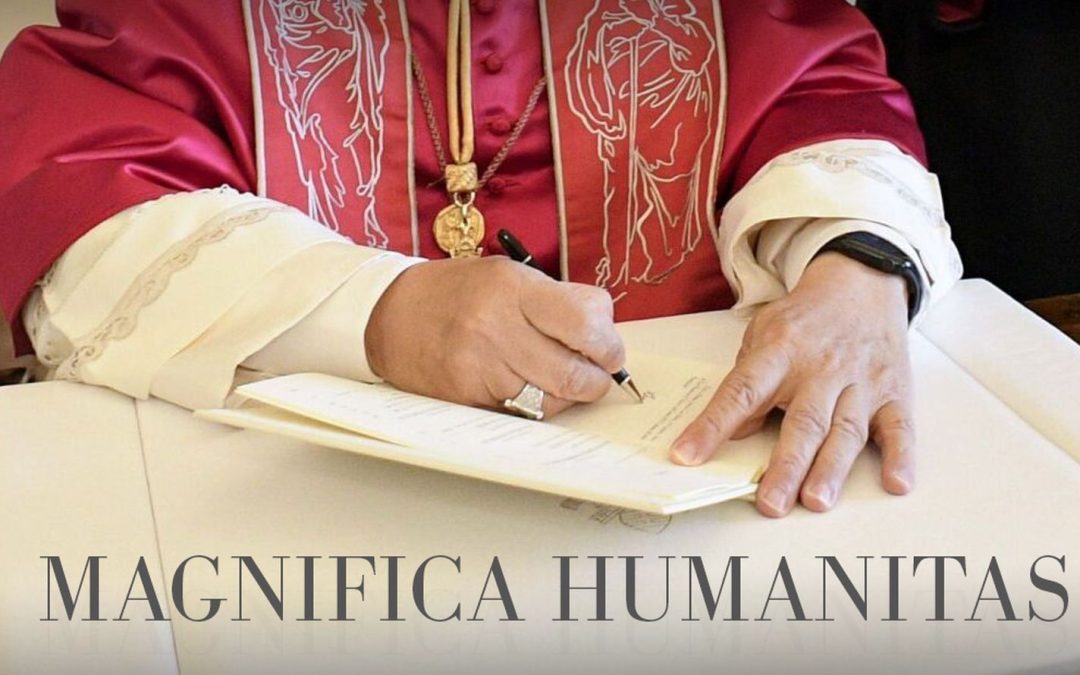
(Vatican) – Published on 25 May 2026, Magnifica Humanitas, the first encyclical of Pope Leo XIV, is devoted to the protection of the human person in the age of artificial intelligence. The document explores the relationship between technology, human dignity and ethical responsibility, calling for the person to remain at the centre of digital progress.
A historic crossroads: Babel or Jerusalem?
Humanity today stands before a decisive choice: to build a new Tower of Babel, founded on self-sufficiency and technological power, or to build the Holy City, rooted in shared responsibility, solidarity and communion between people. The Pope recalls that technological progress is never neutral. Every innovation must be guided by one fundamental criterion: the ontological dignity of the human person, which belongs to every individual simply by virtue of their existence.
Artificial intelligence is not human
The encyclical makes clear that artificial intelligence systems, however extraordinarily powerful they may be, remain foreign to genuinely human experience. They have no body, do not experience joy or suffering, and know nothing of love, moral conscience or a sense of responsibility. For this reason, Leo XIV warns that it is dangerous to entrust algorithms with decisions concerning people’s rights, dignity or reputation, thereby reducing human existence to a mere calculation of efficiency.
Three areas in which the human must be protected
The Pope identifies three decisive challenges for the future of civic life: truth, work and freedom. In an increasingly digital ecosystem exposed to disinformation and manipulation, truth must be safeguarded as a common good essential to democratic life and social trust. Technological innovation must remain centred on the person, while automation must not become a tool of exclusion, precariousness or the loss of the dignity of human work. Finally, the space of personal decision must be defended from new forms of social control, surveillance and digital dependence that risk limiting genuine freedom.
A firm “no” to technological war
Particularly strong is the encyclical’s appeal regarding the relationship between technology and violence. Pope Leo XIV states firmly that “no algorithm can make war morally acceptable.” Any attempt to delegate lethal decisions to automated systems is rejected, while the Gospel of peace is affirmed as the alternative to the logic of force and technological supremacy.
Towards a civilisation of love
In his concluding message, Leo XIV urges people not to fear technology, but to inhabit it with responsibility and wisdom, promoting a new humanism capable of placing the person at the centre. We are called to be “builders of communion and not architects of Babel”, so that artificial intelligence may become a tool in the service of the common good and contribute to the building of a more just, solidaristic and reconciled humanity.
We invite readers to read the full text of the encyclical in order to deepen a reflection that touches some of the most important issues of our time and offers valuable guidance for navigating the challenges of the digital age.
To read the full text of the encyclical, visit the Vatican website here: Magnifica Humanitas – English.