Welcome at San Michele and the Start of Formation
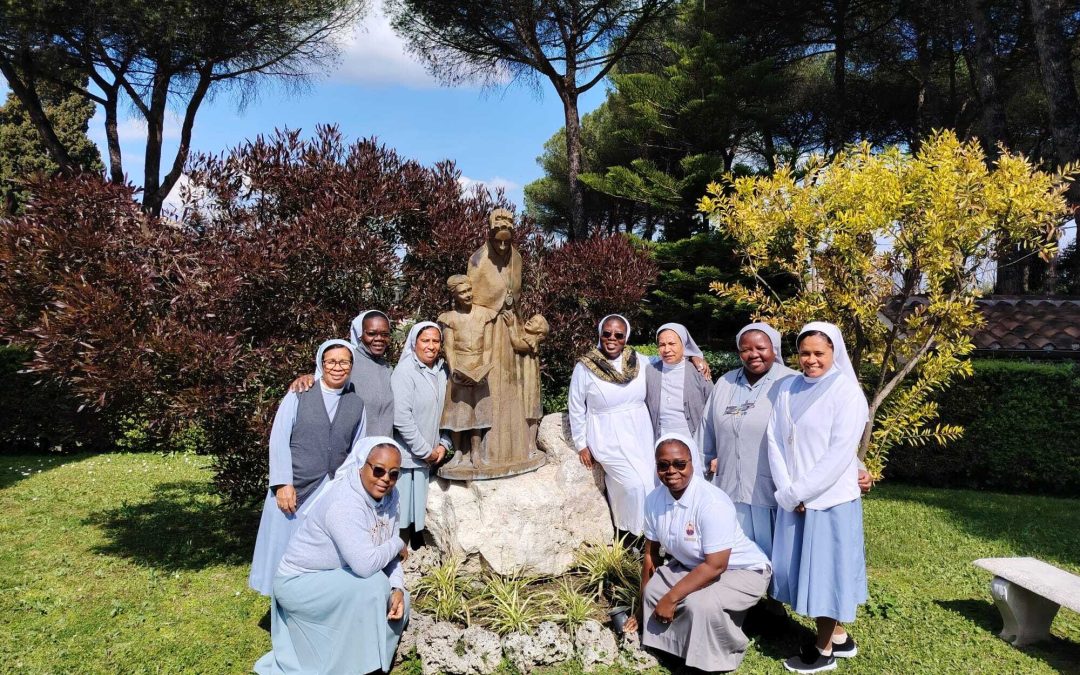
We come from many different cultures (Togo, Angola, São Tomé and Príncipe, Timor-Leste), yet we perceive a single atmosphere of the same charism and spirituality; with our diversity, we enrich one another in faith.
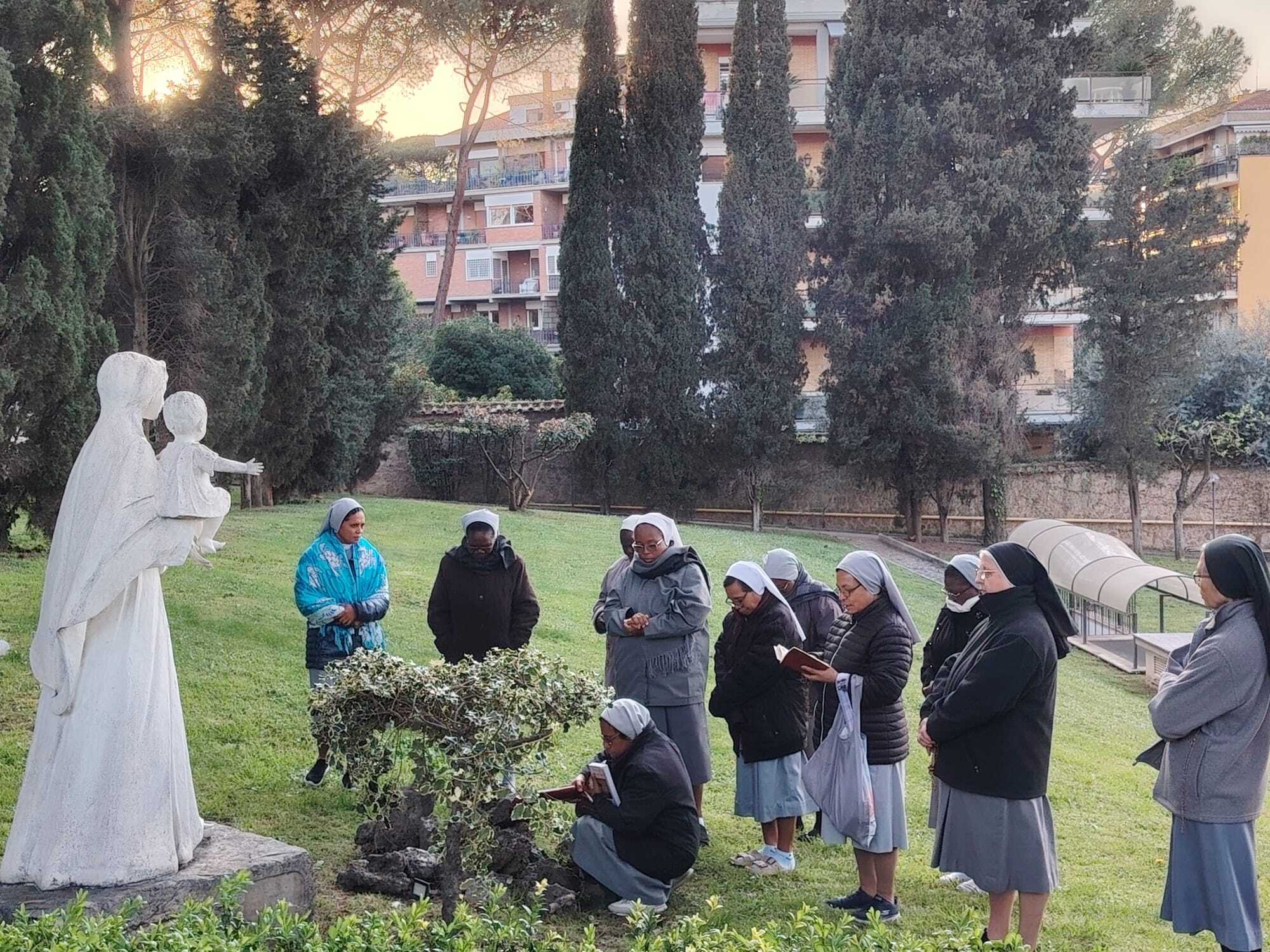
Our journey began the day before the formation, upon arrival at San Michele. We were welcomed with great affection, with the heart of a mother and sister, and accommodated in the houses. Nothing we could desire was lacking. The next day, we began our charismatic formation with the opening Mass, celebrated by Father Tadeo Timada, FdCC. It continued with a brief history of the San Michele House, a visit to the exhibition, and Mother Matilde showed us the garden around the house.
Maddalena di Canossa: Writings and Mystical and Spiritual Experience
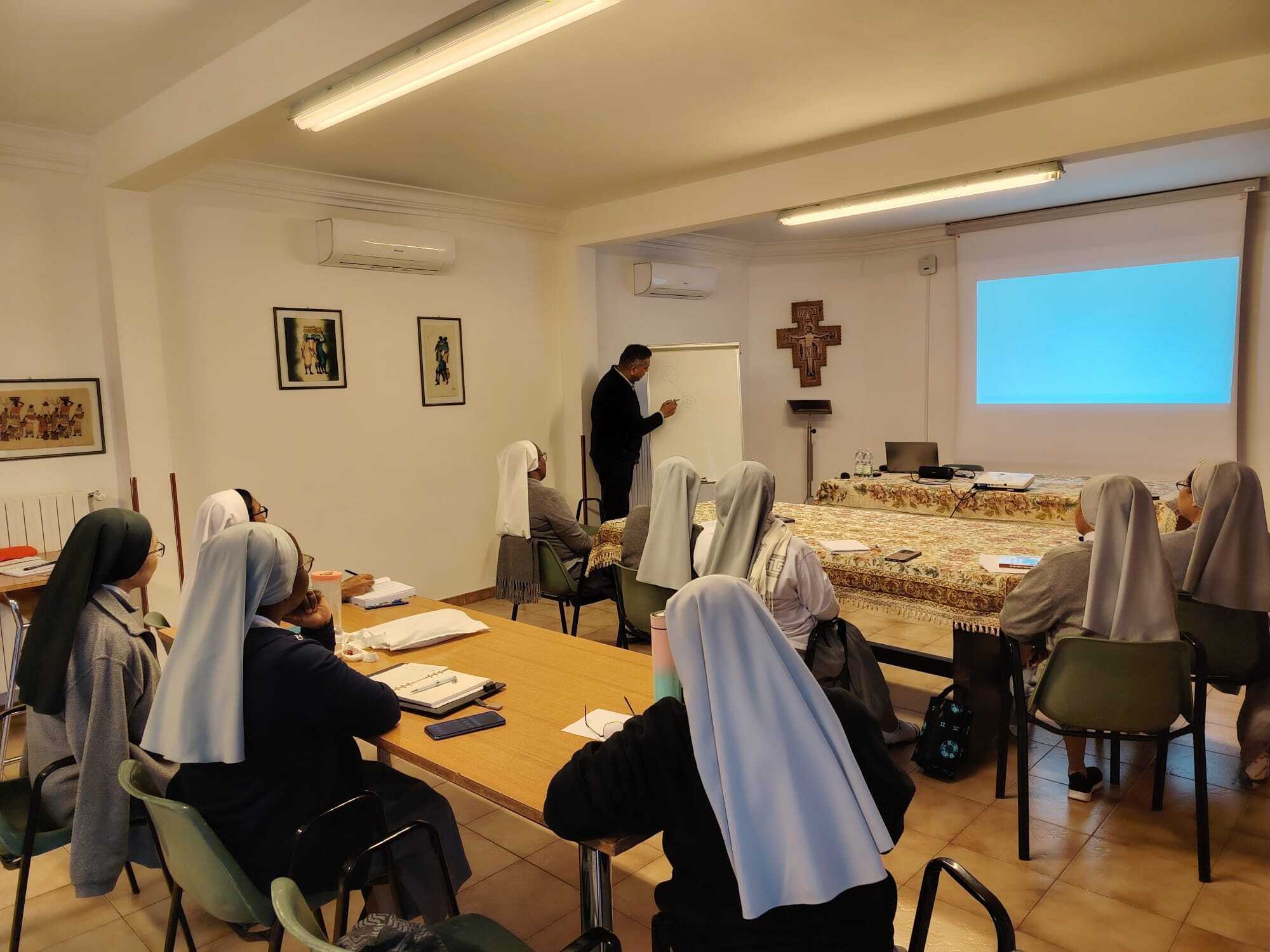
The following day, Mother Rosa Maria Rota helped us understand how to read the writings of Saint Maddalena di Canossa; at the same time, Mother Sandra Maggiolo led us to reflect on Saint Maddalena di Canossa’s journey through six conditions in the spiritual direction of Don Luigi Libera. We also had time to share our cultures while living the Canossian Charism and Spirituality, where the Missionary Mothers began Maddalena di Canossa’s work.
We reached the moment when Father Andrea FdCC, our Canossian brother, led us to enter deeply, body and soul, into the Canossian charism and spirituality, saying:
The Mystical and Spiritual Experience of Maddalena:
The spiritual journey of Saint Maddalena Canossa develops around five mystical experiences (c. 1795), which are not isolated episodes but the heart of her charismatic life. The fifth experience, linked to the verse “Inspice et fac secundum exemplar” (Look and act according to the example), represents the central point and decisive turning point of her journey. Maddalena’s spiritual life can be summarised in two main phases:
- Interiorisation (1792–1799): With Don Libera, she learns to live the charism within herself.
- Foundation (1800–1820): She puts charity into practice, opening the works.
In between is a period of “incubation” (1795–1811): 16 years in which the mystical experience (of Inspice) matures in silence, until it becomes concrete mission in Venice.
Inspĭcĕre (Inspice) means “To Contemplate”, literally the action of “looking within”, that is, examining attentively, reviewing, inspecting; it implies a pause with what is being observed. Inspĭcĕre expresses all the emotional tension: “contemplating in the sense of dwelling”, stopping and scrutinising in all its folds the dedication with which Jesus gives himself for the Father and for all humanity. It is not simply observing an object to reproduce its appearance. Rather, it is deeply familiarising oneself with Christ’s humanity, admiring it, allowing oneself to be conquered and drawn by it, placing in Him all one’s relational energies and one’s entire inner world. To contemplate means to fix one’s dwelling in the humanity of the Crucified One who reveals God’s heart.
Facere secundum exemplar expresses the effects of contemplation lived in this way. The “doing” is the conformation of one’s own humanity to that of the Crucified. By loving God with a human heart, dwelling in the humanity of Jesus on the cross, one is progressively transformed by this very relationship of union, finding oneself endowed with the capacity to love humanity with a divine heart, with the same intense passion of the Father. Făcĕre (Facere) means “to do”: like an artist who looks at a model and reproduces it faithfully.
Another aspect is the Canossian apostolate as educational mission today and what the educational challenge means: Making Jesus known and loved does not mean merely explaining the story of the Saviour well with words, but above all allowing others to experience Jesus’s humanity through one’s own humanity. Father Andrea made this clear by explaining how Maddalena, in the introduction to the school rule, spoke of the need to “welcome” and offer a place to those who have no place.
Educate, Instruct, and Empower
From the Canossian mission experience conceived by Maddalena and Plan B.6, we extracted three key words: “Educate, instruct, and empower”. These three actions are a single educational action. They arise from the conviction that every person, whatever their situation, has within them a sacred value and the desire to realise themselves as a human being.
Father Andrea explained these three essential verbs:
- Instruct: To care for what matters and the truth of another’s life. It also means opening new horizons, helping others understand the world, putting words to what they live, giving voice to their experience, calling by name what happens inside and outside them.
- Educate: To care for the heart and freedom of others, accompanying them to recognise themselves, discover their value, and seek freedom and goodness.
- Empower: To care for the autonomy and protagonism of others, enabling them to act, play a role in the world, and contribute to community life.
Maddalena di Canossa: A Woman of Faith
Finally, linking all these reflections, Mother Josephine Dusi introduced us to the life of Maddalena di Canossa as a woman of faith. How did she live faith? In what way? What is the essence of her faith? Mother Josephine Dusi quoted some phrases from Maddalena’s Written Rule regarding faith. In Maddalena’s Written Rule are these writings, where she spoke of abandonment to God, confidence in God’s Providence, trust in God, docility to God, passing from temptation to confidence in God, and obedience to God’s will.
Creed, Spirituality, and Discernment
Father Bryan Lobo SJ also explained the difference between Creed and Spirituality, and Ignatian discernment. He highlighted various theological, philosophical, and ecclesial perspectives on the concept of Creed and Spirituality. He made us understand that Believing is the synthesis of the essential contents of Christian faith, a formula summarising dogmatic truth; whereas Spirituality is a broader concept, often defined as the intrinsic human capacity for self-transcendence.
He spoke about discernment, explaining it with some questions and treatises on cases. For Ignatius, discernment is a path towards peace, serenity, and consolation, because in this way one is more available to God’s will and the Holy Spirit can act better. This process concerns both psychology and spirituality, hence a good spiritual director is needed.
Thanks!
These are the points we journeyed together, reflecting for the integrity of our Canossian life.
We thank God for this time of grace, a time of return and renewal of Canossian charismatic spiritual life. We also thank Mother Sandra Maggiolo and her counsellors for giving us the opportunity to deepen, entering the charismatic life in a more tangible way and recalling the experiences lived.
We humbly thank our Province and Delegation, which chose us to renew our faith by living the charism and spirituality of our one Mother, Maddalena di Canossa.
Sister Imelda Coimbra