


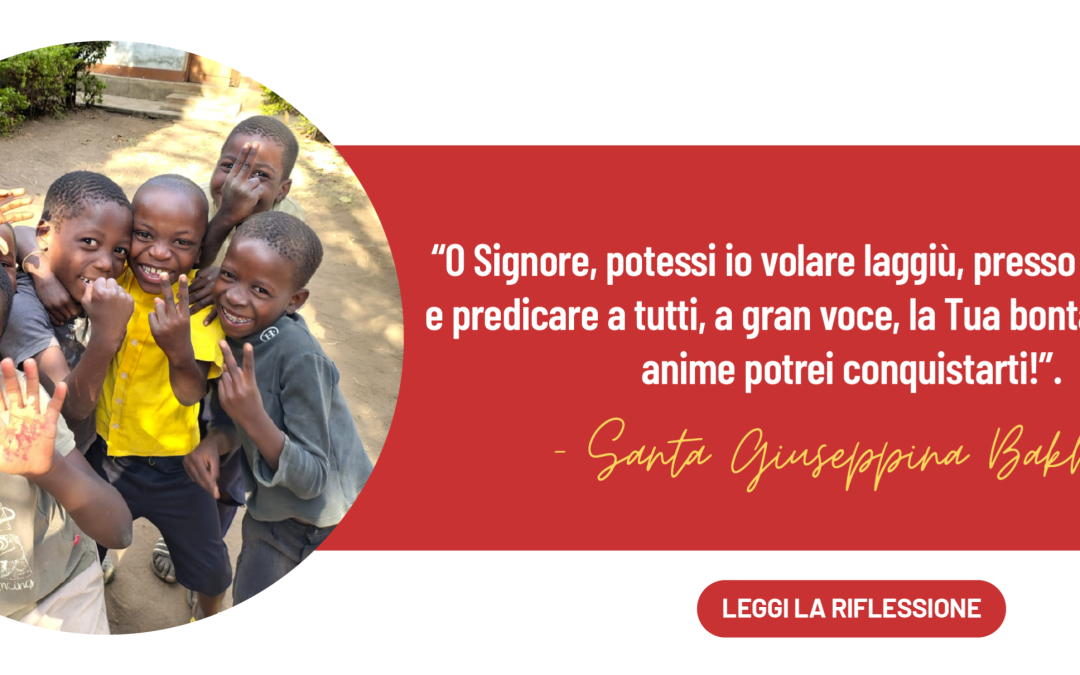
On 8 December 1896, Josephine Bakhita consecrated herself to God in order to give herself to her brothers and sisters. On that day, as she professed her vows as a Canossian Daughter of Charity, she expressed the deepest desire of her heart in these words: “O Lord, if only I could fly back there, to my people, and proclaim Your goodness to everyone in a loud voice! Oh, how many souls I could win for You!”
These words did not arise from a passing enthusiasm. They were the fruit of a life that had passed through the deepest suffering and had been touched by the love of God. Those who have been loved in this way cannot remain silent.
An experience that cannot be kept to oneself
To experience the love of God—his good and transforming love—is an inner reality that cannot be contained. It asks to be expressed, shared and offered, so that others too may draw close to the Lord and discover what we have discovered. Those who know themselves to be loved cannot keep this treasure to themselves.
This proclamation, however, is not made through words alone. Above all, it is made through life: through an existence transformed by that Love which is never outdone in generosity and goodness. Witness is more convincing than speech, and the gaze, manner, patience and joy of a reconciled person speak more powerfully than any explanation.
A wounded history, a redeemed life
Bakhita experienced suffering from childhood. Born in Sudan, she was taken from her family and sold into slavery several times. Even her name was taken from her: “Bakhita”, meaning “fortunate”, was the name imposed on her by her captors. She carried the marks of violence and uprooting in her body and memory.
Yet she did not remain trapped in her experience of suffering. She moved beyond it. Along her journey, she came to know God and discovered that she had never been alone: the One whom she would later tenderly call her Paron—her “Master”—had accompanied her always.
She came to understand that her life, with all that she had experienced, was neither the result of chance nor a story of abandonment. It was part of a greater plan, a design of love conceived from the beginning. The One who had thought of her as his own from her mother’s womb had never let go of her hand.
This certainty transformed the way she looked upon her past. She did not deny or minimise her suffering, but saw it in the light of God’s goodness. From this emerged her ability to forgive, to serve with simplicity and to radiate a peace that her Sisters and all who met her recognised as something that did not come from her alone.
A life given in service
For decades, Bakhita lived humbly in the Canossian community in Schio, Italy, carrying out the simplest tasks: cook, sacristan and porter. From that hidden place, she became a welcoming presence to everyone.
Her smile, gentleness and serenity spoke of God without the need for lengthy explanations. Her desire to “fly” towards her people was fulfilled in a way different from what she had imagined: not by crossing the seas, but by making her daily life a silent proclamation of God’s goodness—a proclamation that reached much further than she could ever have foreseen.
A sister to everyone
Today, our Universal Sister continues to speak to us. Her story belongs not only to the past. It is a living memory for those who suffer slavery and human trafficking today, a source of consolation for those who carry wounds that seem never to heal, and a testimony that no human story is lost to God.
She invites us to experience this good and merciful Love, to allow ourselves to be encountered by him and to let him transform us. Then, once transformed, she invites us to do as she did: to go out to meet others, with the right word at the right time and, above all, with a life that speaks of the goodness of God.
Saint Josephine Bakhita, pray for us.