Pilgrims of Hope in the Footsteps of the Japanese Martyrs
Today we invite you to join us on a very special pilgrimage — to the prefecture of Kumamoto on the island of Kyūshū,Japan
No need to pack a suitcase or check the expiry date on your passport: simply settle into your favourite chair with a cup of tea, and let words turn into images.
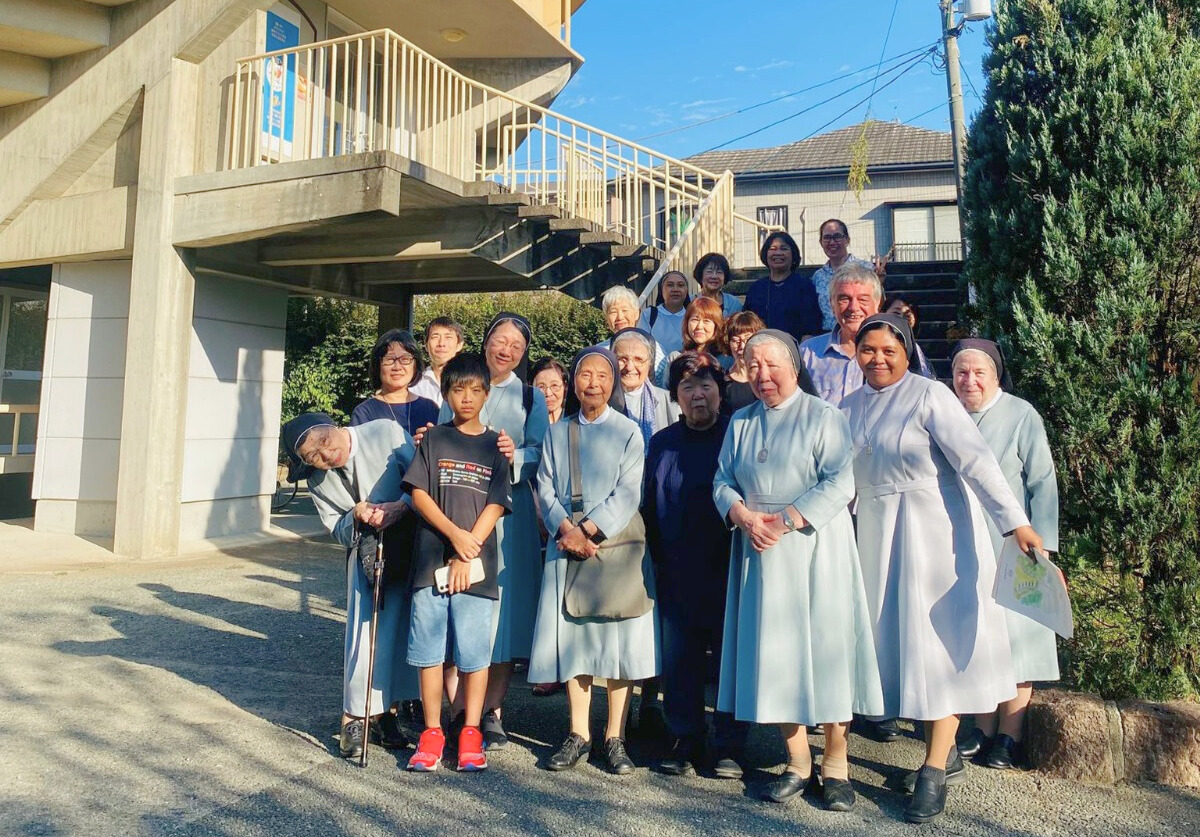
We will be joining the pilgrims, Canossian Sisters and members of the Lay Canossian Association, who made this pilgrimage of hope, faith and gratitude.
Our route will take us to two Jubilee churches,the first in Yatsushiro,and to a memorial park built on the site of a seventeenth-century martyrdom. Then on to the church of Shimazaki, whose architecture evokes a ciborium,and where a great canvas portrays the final prayer of the martyrs.
It is a quiet pilgrimage beginning with the celebration of the Eucharist and woven with prayer and encounters — with Irish and Italian missionaries — and with local stories that intertwine the long history of Japanese Christianity with the rhythm of everyday life today.
Are you ready to follow them?
At the Threshold of the Jubilee
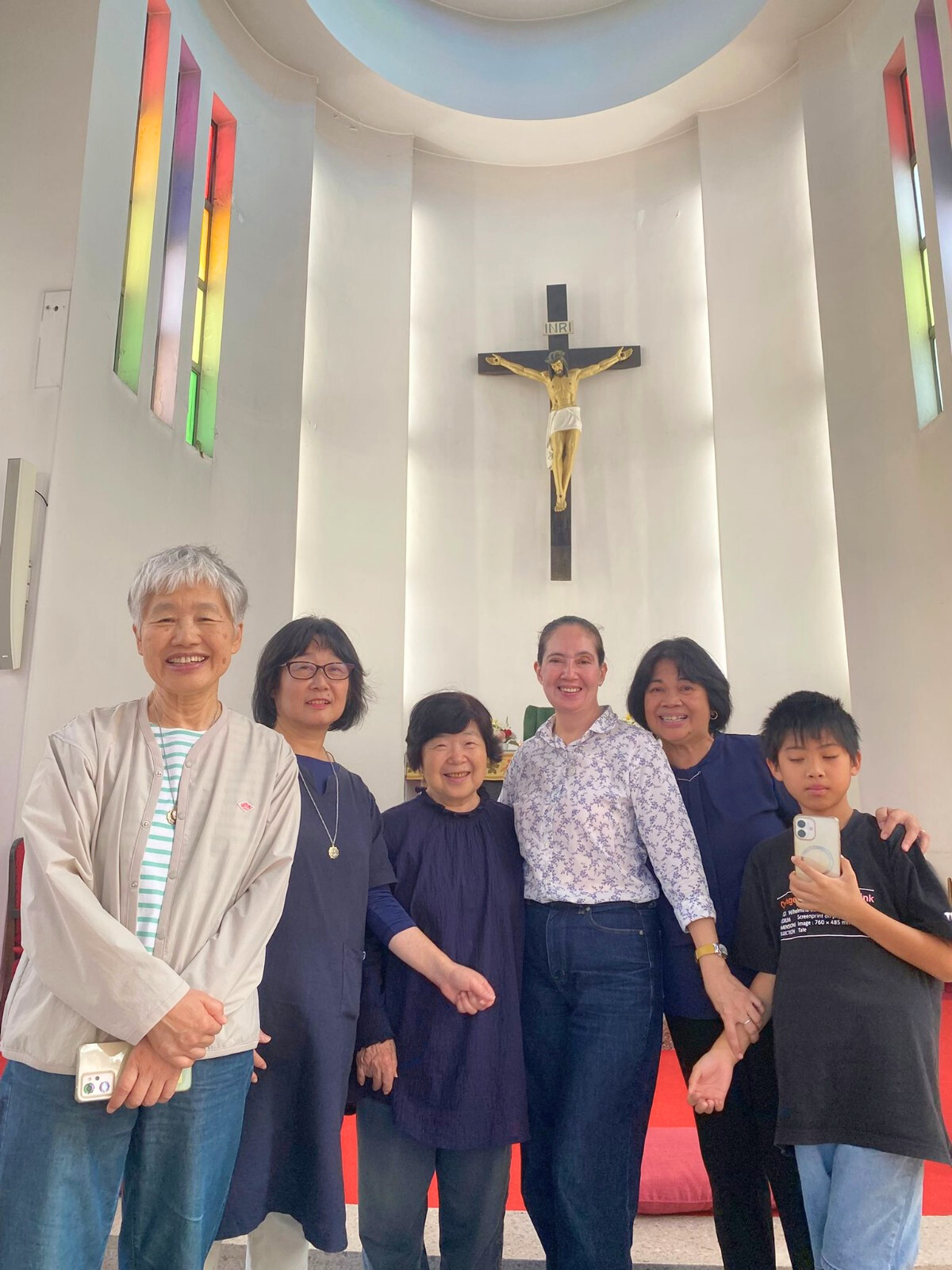
Your journey to Kumamoto will take you along the highway between fields of ripening rice plants, and wooded hills. As you cross wide rivers your eyes are drawn to the Aso mountains in the distance partly shrouded in the morning mist, a promise of another warm Autumn day. In a quiet neighborhood of the industrial city of Yatsushiro, we find the church, an impressive European style building with beautiful stained glass windows.It is one of the churches designated for the Jubilee of 2025.
After a warm welcome by the parish priest — an Irish missionary of the Missionary Society of Saint Columban- and a group of parishioners we enter the church and pause for a moment of silent prayer. One of the parishioners gives us a short talk on the martyrs of this region and then we pray together and sing the Jubilee Hymn in Japanese. There is a tangible sense of being united with those who chose to follow Christ even at the cost of their lives, and with pilgrims who still travel from every corner of Japan, breathing that universal atmosphere which stretches from Rome to even the most distant communities.
After our prayer we share a simple meal with the parish priest,and a few parishioners who, in their calm, gentle way, speak of family life, work, and school.
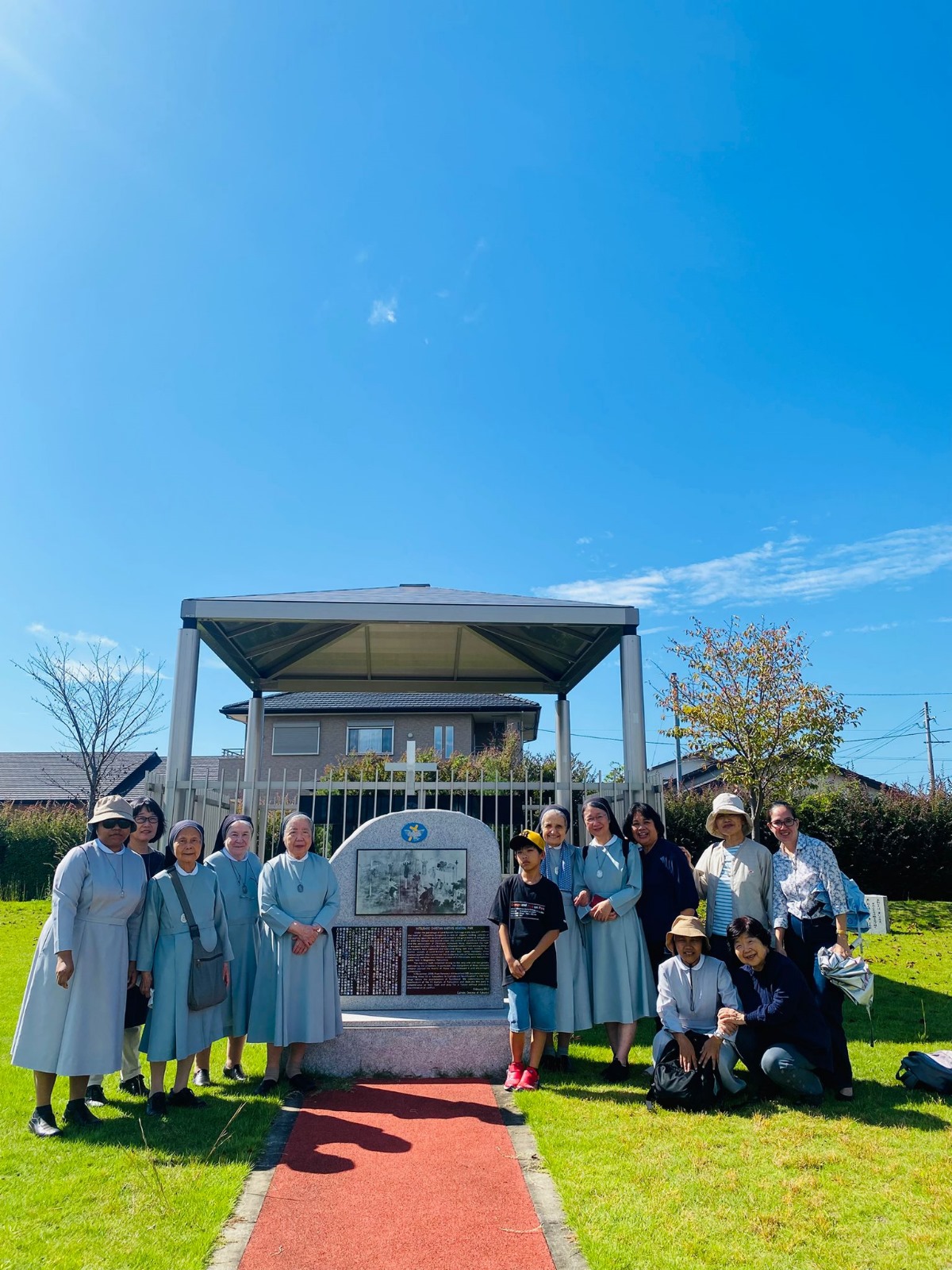
Our path then leads to a quieter yet precious place: the site of the martyrdom of two local families. On December 8th. 1603 the samurai IOANNES MINAMI GORŌ ZAEMON was taken to the city of Kumamoto to be publicly beheaded as a warning to others. The following day his wife and seven-year-old son were crucified along with SIMON TAKEDA GOHYŌE, his mother, and his wife, here in Yatsushiro. It is now a small memorial park lovingly created and cared for by the Society of St Columban and the parish of Yatsushiro. An altar, a commemorative plaque and simple wooden crosses , one for each of these martyrs here, are the only visible signs of the fidelity that, in the seventeenth century, cost men, women and children of Kumamoto their lives.
In those early years of the 1600s, this region of Kyūshū was among the most vibrant centres of Christianity in Japan.
In Yatsushiro, the benevolence of certain local lords allowed a brief flowering of faith before the persecutions began.
A Light that Endures
The pilgrimage continues as we cross the river and head towards Kumamoto. On the outskirts of this castle city we reach the Jubilee church of Shimazaki, where the samurai OGASAWARA YOSABURŌ GENYA, his wife, eight children and three servants were executed in 1636.
Our pilgrims are welcomed by the parish priest — an Italian Xaverian — and the parish team resposible for caring for pilgrim groups. We pray together and then we are guided around the church, designed in the form of a ciborium.
A great canvas depicts the martyrs gathered in prayer before death: clear faces, hands joined, light trembling across the floor.
Throughout the diocese of Fukuoka the memory of these witnesses is alive.
In November 2008, Pope Benedict XVI approved the beatification of a large group of Japanese martyrs, placing the stories of Kumamoto within the wider map of the nation’s sanctity.
Memory and Hope
Japan guards its traditions with quiet grace.
Religious life here is expressed through gestures of simplicity and symbol — the soft glow of paper lanterns, the cleansing water at a shrine, the bow at the threshold.
Alongside these, small yet steadfast Christian communities continue their journey of faith, interwoven with the fabric of local history.
In Yatsushiro, for instance, each November the Myōken Festival is celebrated: horses, mikoshi (portable Shintō shrines) and traditional dances animate the streets.
This ancient festival, now recognised as part of Japan’s intangible cultural heritage, reminds us that faith, memory and place can live together in harmony.
Pilgrims of Hope
For our Canossian pilgrims of Japan, this day was far more than a journey.
It became a way of walking through memory — of drawing strength from the courage of the martyrs and from the quiet fidelity of those who, four centuries ago, refused to renounce their faith.
To enter a church that welcomes, to linger in a park that remembers, to listen to stories of missionaries from afar and of families who still bear witness to the Gospel in daily life — all this became prayer in motion, faith on the move.
As we make our way home, the autumn sun goes down over the Ariake Sea and the light of evening settles gently over the road ahead.
In the hush that follows, one truth remains:
Hope grows whenever memory becomes a path.
And so we give thanks to God for the wonders He continues to work in Japan, and pray for the grace to be living witnesses of His Provident Love — even here, in this Land of the Rising Sun.