


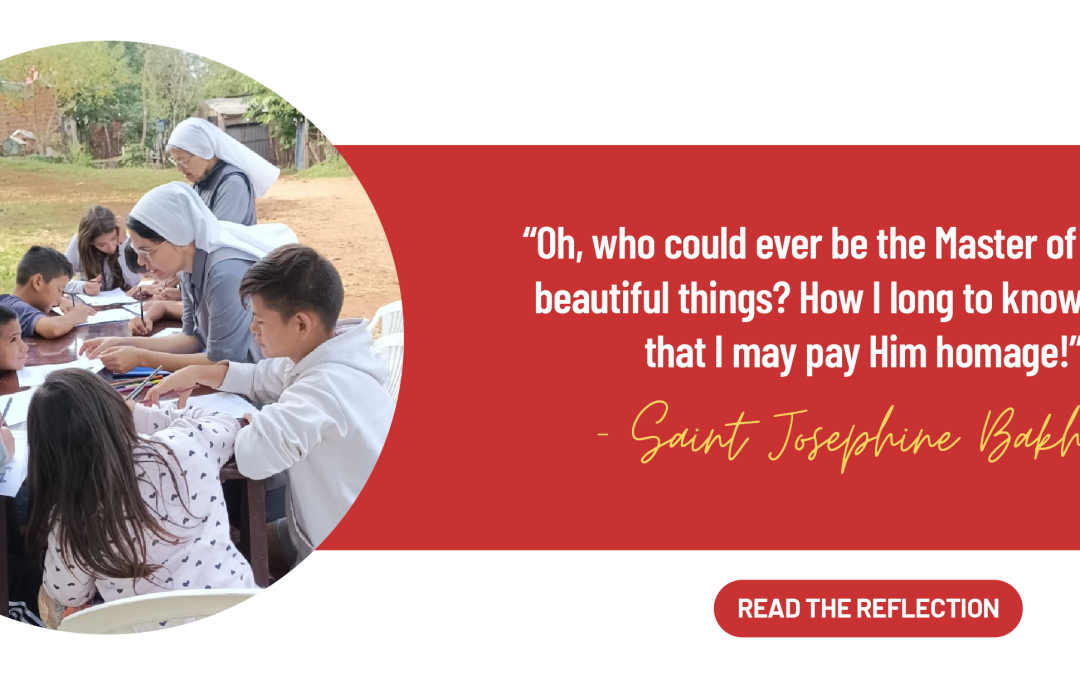
“Oh, who could be the Master of all these beautiful things? How I would love to know him, to pay him homage!”
Tradition tells us that little Bakhita, still a child in her native Sudan, and later during the dark years of her captivity, would lift her gaze to the sun, the moon and the stars, and would ask herself, with the pure heart of one uncorrupted by cynicism: to whom does all this belong? She did not ask out of scientific curiosity, but out of love. She sensed that such beauty could not be an orphan — that behind so generous a sky there had to be Someone to whom it belonged, Someone worthy of being recognised and honoured.
It is moving to think that this question arose precisely in the heart of a child torn from her home, sold as a slave, stripped of her name and her freedom. Life had taught her that human beings could treat her as a thing, as property without value. And yet, before creation, Bakhita did not reason as a slave, but as a daughter. She did not see in the “Master” of the universe a lord who dominates, but a Father to whom homage could be paid with gratitude and tenderness. Here, already in seed, lies the whole of Christian revelation: the true Lordship of God does not oppress, it liberates; it does not possess in order to exploit, it possesses in order to love.
Over the years, this childhood intuition became the centre of her whole spiritual life. When she finally came to know that “Padrone” — through the Canossian Sisters in Venice, through Baptism, through the Eucharist — Bakhita never stopped calling him by that simple, trusting name: il Paron, “the Master”. But now she knew that this Master loved her with a love so great that it had given her the strength to forgive those who had mistreated her. Her celebrated words — “if I were to meet those who enslaved me, I would kneel and kiss their hands, for if that had not happened, I would not today be a Christian and a religious” — can only be understood in the light of this discovery: having finally found the true Master of all beautiful things.
For us today
Bakhita’s question remains as relevant as ever. We live surrounded by beauty — a sunrise, a beloved face, a child’s smile, the vastness of the sea — and we often pass it by, without asking ourselves where so great a gift comes from. Her example invites us to recover that contemplative and grateful gaze: to let the beauty of the world always point us back to its Author, and to respond, as she did, with a sincere desire to know him and to pay him homage.
The Canossian charism, which welcomed Bakhita and enabled her to flourish as a daughter of God and a religious, remains today a gift for the whole Church: Sisters, lay people, families and all who share this path of charity. To everyone comes the same invitation: to guard that contemplative gaze, to recognise in every person — especially in the poorest and most cast aside — a reflection of those “beautiful things” that belong to God, and to commit ourselves, each according to our own vocation, to loving them, respecting them and freeing them from every form of slavery.
Saint Josephine Bakhita, you who sought the Master of heaven and earth and found him in the face of Christ, help us too to recognise him in the beauty of creation and in every brother and sister who comes to meet us. Amen.