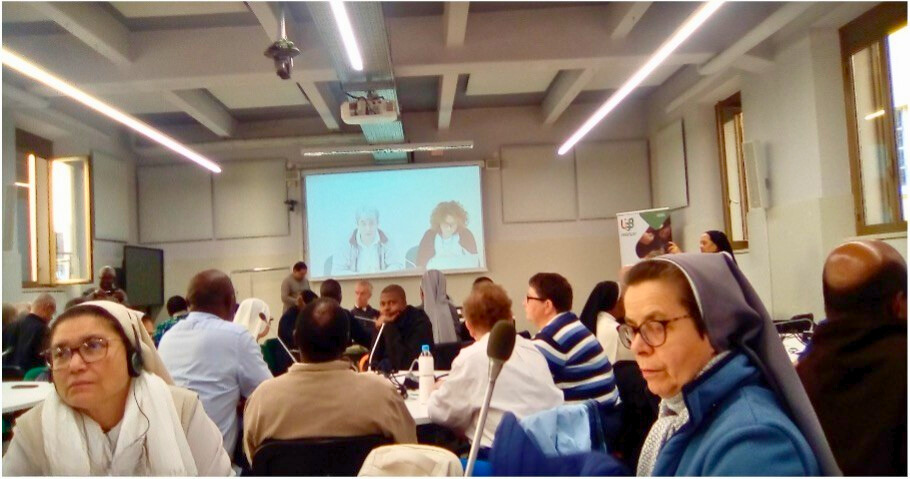
In the Regina Mundi Hall of the UISG building in Rome, the Annual General Assembly of the JPIC Commission – USG & UISG was held on Wednesday, 12 November, under the theme:
“Dilexi Te: ‘I Have Loved You’ – Renewing the JPIC Mission through Contemplative Action and Prophetic Witness.”
Eighty-one members, religious women and men from various Congregations and linguistic backgrounds, took part in the gathering.
Sr Angela Sartori represented our Institute, which has long been committed to this vital apostolic and missionary field.
Gathered around ten working tables, organised according to the five languages (Italian, English, Spanish, French, and Portuguese), the participants — JPIC Promoters and Coordinators — enriched the reflection through a spirit of deep sharing, offering meaningful insights and indicating new pathways for the JPIC mission, in order to strengthen the common commitment to Justice, Peace, and the Integrity of Creation.
“I Have Loved You”:
From this declaration of love by the Lord springs charity — a force capable of transforming reality, an authentic power for historical change, for it means listening to the cry of entire peoples, especially the poorest of the earth (DT 91).
To hear the cry of the poor and of the earth, allowing ourselves to be evangelised and converted by Love, is today both an urgent call and a sacred challenge addressed to all.
The 2022 Chapter Document reminds us of this with clarity:
“In the third millennium, in a globalised context, as an international Institute, we feel a renewed call to read the signs of the times in the light of the promptings of the Institute’s JPIC document…
Our hearts are moved by the cry of the poor, which continues to rise; the cry of the young urges our care; the cry of the earth demands a swift and faithful response…” (p. 34).
God’s love — for us and for all — must permeate every ministry entrusted to us and take flesh in daily gestures of goodness and compassion.
For, as we read in the same text:
“Christian love is prophetic, it works miracles, it knows no limits: it is made for the impossible.
Love is above all a way of understanding life, a way of living it.” (DT 120).
And so we are called to examine ourselves:
Do we truly love the poor?
How do we encounter them?
Does our love “touch the flesh of Christ” — the hunger, the thirst, the pain, the loneliness of the poor, in whom He continues to identify Himself today?