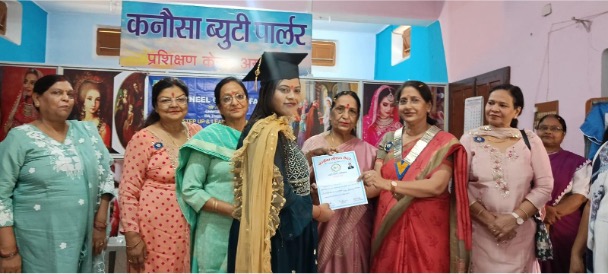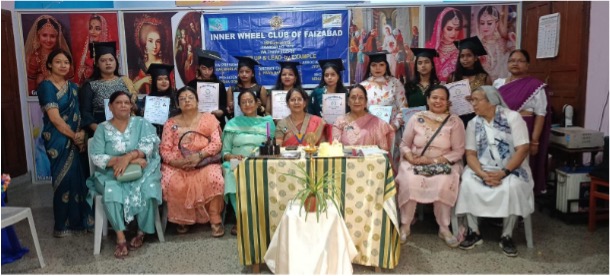
The courtyard of the Canossian Centre in Ayodhya, India, recently became the stage for a joyful, hopeful celebration. Against a backdrop of vividly coloured fabrics, accompanied by the soundtrack of women laughing with the ease of those who have achieved something meaningful, the Centre hosted the Graduation Day of its tailoring course. It was a milestone woven from beauty and tenacity, from threads patiently intertwined with creativity, but, above all, it was a promise of a brighter future.
This was not a formal ceremony but a community celebration. Adding to its charm was the presence of seven members of Inner Wheel, the long-standing women’s charitable association. The current president and her six predecessors arrived smiling, wrapped in bright saris, with the grace and quiet resolve of women who know that social commitment is a daily craft, not an occasional gesture.
These distinguished guests brought gifts that speak of the future: forty metres of fabric to support training courses, and a financial contribution to the Mother’s Meal Program, which provides food for vulnerable families. In a place where a daily meal is not guaranteed, such gestures feel like laying down foundations—solid, tangible, essential. Here, “to sew”seems not only a verb, but a vision.
The visitors then made their way to the Mission Sunday Charity Stall, the Centre’s modest marketplace where its designers sell their handcrafted creations: bags, table linens, small accessories, each shaped by hand. They delighted in buying several items, fully aware that they were stitched with stories and stitched for dreams. Supporting women’s craftmanship is vital, because it means recognising the worth of those who often do not recognise it in themselves.
Among makeshift stalls and fabrics fluttering in the breeze, two words echoed more than any others: “collaboration” and “hope.” Inner Wheel’s leaders insisted this was not a one-off act, but the beginning—or continuation—of a pact: to support women, to encourage education, to foster economic autonomy. Because a needle and a piece of cloth can become an income—and an income can become freedom.
In a country constantly accelerating, full of contradictions yet brimming with possibility, the Canossa Social Centre stands as a workshop of resilience, where craftsmanship is not a charming pastime but a concrete chance to learn a trade, acquire skills, and shape a future.
The day ended with a joyful refrain, repeated almost like a chant:
“Charity charms!”
Charity fascinates, attracts, transforms. And perhaps this is the message that lingered most deeply in everyone’s heart.
In a world where much is made but little is truly created, these women remind us that beauty belongs to those who know how to bring it forth with their own hands—where every stitch is a small act of freedom.